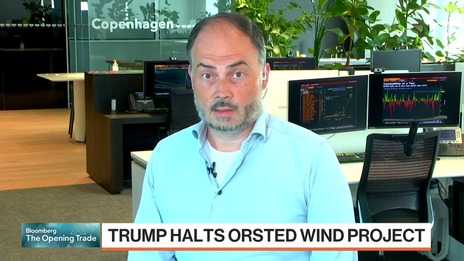
On the Copenhagen stock exchange, Orsted shares were down nearly 3% at 144 Danish kroner (DKK) on Thursday morning, after the release of mixed first-half 2026 results. Against the backdrop of volatility in global energy markets, the Danish energy group generated EBITDA (excluding new partnerships and cancellation fees) of 15bn DKK, up 8% year over year.
Net profit, however, fell 60% year over year to 3.3bn DKK. The sharp decline was mainly due to disposal gains booked the prior year, as well as higher taxes and non-cash impairments this year.
Over the first six months of 2026, revenue at the wind energy specialist accelerated to 48.27bn DKK from 37.84bn DKK a year earlier over the same period. The increase posted in the 'Power generation' and 'Power sale' segments versus the first half of 2025 primarily reflects the commissioning of new assets and more favorable winds, which lifted output. In the offshore wind segment (Offshore), this higher generation also drove an increase in revenue from public subsidies year over year.
At the same time, revenue from construction contracts on behalf of third parties reached 10.19bn DKK in the first half of 2026, mainly supported by construction of the Hornsea 3 (United Kingdom) and Greater Changhua 4 (Taiwan) wind farms. In the first half of 2025, it totaled 3.606bn DKK and primarily related to the Greater Changhua 4 project.
Cash flows from operating activities followed this positive momentum and came in at 9.1bn DKK in the first half of 2026, versus 7.8bn DKK a year earlier.
ROCE temporarily under pressure
Return on capital employed (ROCE) narrowed to 3.1% in the first half, compared with 7.5% over the same period a year earlier. The decline mainly stems from an increase in capital employed and slightly lower operating profit over the last 12 months on a trailing basis. Orsted nonetheless maintains a path toward high medium-term profitability, targeting an average ROCE of around 11% for 2026-2027 and above 13% for 2028-2030'.
'Recent volatility in global energy markets underscores the need for Europe to accelerate electrification and the rollout of renewable energy. We can see that this priority is recognized at the European political level, where recent EU legislative proposals are specifically aimed at accelerating electrification across all sectors,' said Rasmus Errboe, Orsted's chief executive officer.
Guidance maintained, dividend returns
Despite its mixed results in the first half of 2026, Orsted is reaffirming its financial targets for 2026. EBITDA excluding new partnerships and cancellation fees is still expected to exceed 28bn DKK. Gross investments are maintained at between 50bn and 55bn DKK.
Building on a strengthened financial structure, the Danish company will pursue new growth opportunities in offshore wind and plans to reinstate dividend payments. To reward shareholders, it is prioritizing value creation through earnings growth rather than a high dividend yield.
The reinstated dividend will take into account the strength of its financial structure, the construction program under way through 2027, and persistent regulatory risks and uncertainties. This dividend policy is expected to begin at a modest level as of fiscal 2026 (for a first payment in 2027), then increase each year through 2028.
Orsted A/S is one of the leading Danish energy groups. Net sales break down by activity as follows:
- development, construction and operation of offshore wind farms (72.6%): 18.7 TWh of wind energy produced in 2025. At the end of 2025, the group had an installed capacity of 10.2 GW;
- production and distribution of electricity, gas and bioenergy (23.3%): electricity (2.5 TWh sold in 2025), gas (21.5 TWh sold) and thermal energy (6.4 TWh produced). In addition, the group is developing an oil transport activity;
- development, construction and operation of onshore wind and solar PV farms (3.9%): operation of onshore wind and solar farms with an installed capacity of 6.3 GW;
- other (0.2%).
Net sales are distributed geographically as follows: Denmark (24.6%), the United Kingdom (48.9%), Taiwan (10.3%), Germany (7.9%), the United States (4.2%), the Netherlands (2.3%), Ireland (0.8%) and other (1%).
This super rating is the result of a weighted average of the rankings based on the following ratings: Valuation (Composite), EPS Revisions (4 months), and Visibility (Composite). We recommend that you carefully review the associated descriptions.
Investor
Investor
This super composite rating is the result of a weighted average of the rankings based on the following ratings: Fundamentals (Composite), Valuation (Composite), EPS Revisions (1 year), and Visibility (Composite). We recommend that you carefully review the associated descriptions.
Global
Global
This composite rating is the result of an average of the rankings based on the following ratings: Fundamentals (Composite), Valuation (Composite), Financial Estimates Revisions (Composite), Consensus (Composite) and Visibility (Composite). The company must be covered by at least 4 of these 5 ratings for the calculation to be carried out. We recommend that you carefully review the associated descriptions.
Quality
Quality
This composite rating is the result of an average of rankings based on the following ratings: Returns (Composite), Profitability (Composite) and Quality of Financial Reporting (Composite), and Financial Health (Composite). The company must be covered by at least 2 of these 3 ratings for the calculation to be performed. We recommend that you carefully read the associated descriptions.
ESG MSCI
ESG MSCI
The MSCI ESG score assesses a company’s environmental, social, and governance practices relative to its industry peers. Companies are rated from CCC (laggard) to AAA (leader). This rating helps investors incorporate sustainability risks and opportunities into their investment decisions.